
Manitoba's Cost of Building a House Explained
So, you're thinking about building a new home in Manitoba. It's an exciting prospect, but the first thing on everyone's mind is always the same: what's it going to cost?
The short answer is that the cost of building a house in Manitoba typically runs from $250 to over $400 per square foot just for the construction. That doesn't even factor in the land. For a pretty standard 2,000-square-foot home, you’re looking at a build cost somewhere between $500,000 and $800,000. Of course, that final number can swing quite a bit depending on your location—building in a high-demand area like Sage Creek will cost more than in a rural municipality—and just how fancy you get with the materials and finishes.
Your Quick Guide to Manitoba Home Building Costs
Planning a new build is a huge undertaking, and that big-picture budget question can feel overwhelming. Let's be honest, understanding the real cost means looking past a simple square-foot estimate. As recent coverage from outlets like the Winnipeg Free Press has highlighted, fluctuating material costs and shortages of skilled labour can really shift the goalposts on your final expenses.
This guide is here to break it all down into pieces you can actually work with. We'll walk through every major expense you'll encounter, from buying a lot in a booming community like Niverville to picking out the final finishes that really make a house feel like home. The goal is to give you a clear, realistic financial roadmap right from the get-go.
Key Budget Components at a Glance
Before we get into the nitty-gritty, it helps to see how a typical home-building budget is put together. It's so much more than just the sticks and bricks; you have to account for the land itself, the physical build, and all the professional services that bring it to life.
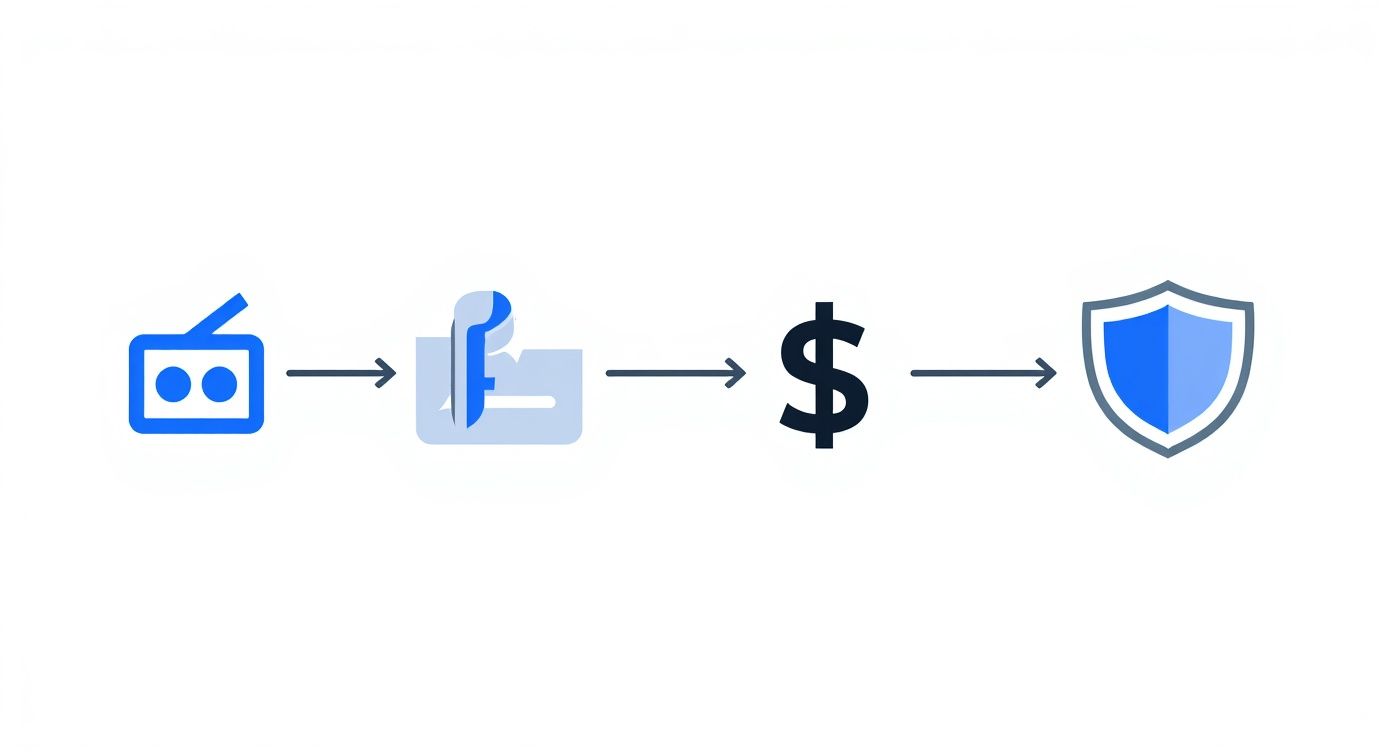
This infographic breaks down the three main pillars of your budget: the land, the construction, and the professional fees (often called soft costs).

As you can see, construction is the biggest slice of the pie, but the land and soft costs are major expenses you absolutely have to plan for. Getting your finances in order is step one, and it's a good idea to learn how to prepare yourself to purchase a home in Manitoba to make sure you're starting on solid financial ground.
A well-structured budget is the blueprint for a successful home build. It anticipates not only the visible costs like framing and flooring but also the essential, often-overlooked expenses like permits, design fees, and a crucial contingency fund.
This overview should give you a solid starting point. With these ballpark figures in mind, you can start making smart decisions that line up your dream home with your financial reality.
Decoding the Cost Per Square Foot Metric
When you start digging into the cost of building a house, you'll hear the term "price per square foot" thrown around a lot. It’s the industry's go-to shorthand, but leaning on it too heavily without knowing what’s behind the number can get you into trouble.
Think of it like buying a car. A dependable sedan and a luxury SUV will both get you from A to B, but their price tags are in different solar systems. Why? Because of the engineering, the materials, the features, and the badge on the front.
It’s the exact same story with building a home. A standard-finish, 1,800-square-foot bungalow in a new Winnipeg development like Sage Creek will have a completely different cost per square foot than a custom-designed home of the same size in a rural municipality like East St. Paul, especially if that custom home has complex rooflines, premium materials, and high-end heating and cooling systems.
That one little number can swing wildly because it’s really just an average of dozens of different costs all mashed together. A builder’s initial quote is often just a starting point. It’s absolutely critical to know what’s inside that number—and even more importantly, what’s been left out.
What Does the Base Cost Usually Include?
So, when a builder gives you a base price per square foot, what are they actually talking about? Typically, they’re referring to the core construction of the house itself. This is the cost to take your project from a hole in the ground to a finished, livable space with a basic level of finishes.
This foundational price covers the "sticks and bricks" and the essential systems needed to make the house function. You can generally expect these items to be part of that initial estimate:
-
Foundation: The concrete work for a standard basement or slab.
-
Framing: All the lumber and labour to build the home's skeleton.
-
Exterior Shell: This includes basic roofing, siding, windows, and doors.
-
Insulation and Drywall: The materials that seal up the home and create the interior walls.
-
Basic Mechanical Systems: Standard-grade HVAC (furnace and ductwork), plumbing lines, and electrical wiring.
-
Builder-Grade Finishes: This means entry-level flooring, cabinetry, countertops, and paint.
These components form the structural and functional heart of your new home. But remember, this base cost is just one piece of a much larger financial puzzle.
What Is Almost Always Excluded?
This is where budgets often go off the rails. The initial per-square-foot cost rarely, if ever, covers every single expense needed to complete your project. As a homebuyer, you have to account for several major costs that fall outside the builder’s standard quote.
The most common budgeting mistake is underestimating the costs that exist outside the builder's initial price per square foot. Items like land, site servicing, and landscaping can add tens or even hundreds of thousands of dollars to the final tally.
To avoid nasty surprises down the road, you need to be ready to budget separately for these crucial elements:
-
The Land Itself: The purchase price of your lot is never included.
-
Site Preparation: This covers everything from soil testing and excavation to connecting to municipal services like water and hydro. For rural properties, this can be a massive expense.
-
High-End Finishes & Appliances: Want to upgrade from builder-grade vinyl plank to engineered hardwood? Or maybe you've got your eye on premium appliances? That's extra.
-
Landscaping and Driveway: The builder's job often stops at the foundation. You’ll need to budget for sod, trees, a driveway, and any walkways.
-
Permits and Fees: Municipal building permits, development charges, and utility hook-up fees are your responsibility to pay.
-
GST: Don't forget that GST is applicable to new home construction and is a significant cost.
Understanding this distinction is the key to having productive conversations with builders and creating a budget that actually works. Always, always ask for a detailed list of inclusions and exclusions. It’s the only way you can accurately compare quotes and plan for the true, total cost of building your house.
The Foundation of Your Budget: Land and Site Prep
Long before the first walls go up, two of the biggest factors in the cost of building a house are already in play: the land you build on and the work it takes to get it ready. These aren't just line items on a spreadsheet; they're the financial bedrock of your entire project. Underestimate them, and you could put your budget in jeopardy before a single nail is hammered.
The price of land here in Manitoba varies dramatically. It's a classic tale of two very different scenarios, and each one comes with a completely different price tag. One path is buying a fully serviced lot in a planned community. The other? Purchasing a raw, unserviced piece of rural land.
Serviced vs. Unserviced Land: A Tale of Two Budgets
Let's say you're looking at a fully serviced lot in a growing community like Steinbach or Niverville. You can expect these lots to run between $90,000 and $150,000. While that might seem like a big number upfront, that price includes all the critical infrastructure. The developer has already done the heavy lifting and paid to run municipal water, sewer, natural gas, and hydro lines right to your property line. It’s pretty much a "plug-and-play" situation for your builder.
Now, let's look at the alternative: a beautiful 2 acre lot in Mitchell might look much more attractive, maybe around $120,000. But this is where the hidden costs start to creep in. This is raw land with no connections, which means you're on the hook for creating your own essential services from scratch.
The sticker price of land is only half the story. The true cost comes out when you factor in all the services required to make it a place you can actually live. An unserviced lot demands a serious extra investment that has to be part of your initial budget.
For a rural build, you'll need to add several major expenses that a city lot owner gets to avoid:
-
Drilling a Well: Getting clean water can cost anywhere from $10,000 to $20,000, depending on how deep they need to drill.
-
Installing a Septic Field: A modern septic system isn't just a tank in the ground; it's a complex engineering project that often costs $25,000 to $40,000 or more to design and install.
-
Hydro Connection: Bringing electricity from the nearest main line to your building site can add another $10,000 to $30,000, all depending on the distance.
Suddenly, that "cheaper" rural lot can end up costing you $45,000 to $90,000 more than a serviced lot in town before you've even broken ground. If you're exploring your options, it's a good idea to check out listings for vacant land in Southeast Manitoba to compare prices and see exactly what services are included.
Site Preparation: Getting the Ground Ready
Once you own the land, the next job is preparing it for construction—and this is way more involved than just clearing a patch of grass. This phase is especially critical here in Manitoba, where our dense, heavy clay soil, often called "gumbo," brings its own unique set of challenges.
The site prep process involves a few non-negotiable steps:
-
Excavation and Grading: Heavy machinery comes in to dig the basement, level the site, and make sure water will drain properly away from your future foundation. The cost really depends on the size of your home's footprint and how much earth needs to be moved around.
-
Utility Trenching: Even on a fully serviced lot, trenches still need to be dug to connect the municipal lines from the street to your house.
These site prep costs can easily tack on another $15,000 to $50,000 to your project, depending on how complex your property is. Together, land and site prep form the first big chapter of your home-building budget, setting the stage for everything that comes next.
From Framework to Systems: Breaking Down Hard Costs
Once your land is secured and the site is prepped, we get to the really exciting part—the "hard costs." This is where blueprints and dreams start turning into an actual, physical structure. It’s everything from the foundation under your feet to the shingles over your head.
Every decision you make from here on out can swing your budget one way or another. This is the "sticks and bricks" stage, and it's easily the biggest chunk of your total build cost. Let's walk through the major phases and what you can expect to spend right here in Manitoba.
Pouring the Foundation
Your home's entire structure rests on its foundation, and in Manitoba's notorious clay soil, getting this right is absolutely critical. The most common and reliable option here is a piled foundation with a full concrete basement.
You’ve probably heard locals talk about our "gumbo" soil—it shifts, expands, and contracts. A piled foundation involves driving steel or concrete piles deep into the ground until they hit stable soil, anchoring your home and preventing those dreaded cracks down the line. For a typical 2,000 sq. ft. house, you’re looking at a cost between $30,000 and $50,000 for a solid, piled foundation.
Building the Skeleton: Framing and Roofing
After the concrete has cured, the framing crew rolls in, and your house finally starts to look like a house. This is the skeleton—the floors, walls, and roof structure that give your home its shape. The cost here is heavily influenced by two things: the ever-fluctuating price of lumber and how complex your home’s design is.
A simple, rectangular bungalow is much cheaper to frame than a sprawling two-storey with intricate rooflines and custom angles. For an average home, a good budget for the complete framing package is $60,000 to $100,000+. Following that is the roof. Standard asphalt shingles might run you $8,000 to $15,000, but if you opt for something more durable like a metal roof, expect to pay at least double that.
Every extra corner, every tricky angle, and every dramatic roofline adds to both material and labour costs. The most cost-effective designs are always the simplest ones.
The Exterior Shell: Windows and Finishes
With the frame up and the roof on, it's time to wrap the house and protect it from the elements. Your choice of exterior finishes is another area where your personal taste directly impacts the bottom line.
Here are the go-to options in Manitoba:
-
Vinyl Siding: The most budget-friendly choice. It’s durable, low-maintenance, and gets the job done.
-
Engineered Wood or Fibre Cement: A step up in both look and cost, offering a premium finish and great durability.
-
Stucco or Stone Accents: These are high-end finishes that add major curb appeal but come with a much steeper price tag for both the materials and the specialized installers needed.
All in, you should budget between $20,000 and $60,000 for your home’s complete exterior. Windows are another huge piece of this puzzle. Given our winters, triple-pane windows are the undisputed standard for energy efficiency. A decent package for a new home will likely cost $25,000 to $40,000. If you start adding massive picture windows or custom architectural shapes, that number can easily soar past $70,000.
The Inner Workings: Mechanical Systems (MEP)
Tucked away behind the drywall are the systems that truly make your house a home: Mechanical, Electrical, and Plumbing (MEP). They aren't the most glamorous expenses, but they’re absolutely essential.
Here’s what you can expect:
-
HVAC (Heating, Ventilation, and Air Conditioning): This covers your high-efficiency furnace, all the ductwork, and central A/C. Budget $15,000 to $25,000 for a standard, reliable system.
-
Electrical: This includes all the wiring, the main panel, outlets, switches, and the labour to install basic light fixtures. A typical cost is $15,000 to $25,000.
-
Plumbing: This is for running all the supply and drain lines to your kitchen and bathrooms. The "rough-in" stage usually lands between $12,000 and $20,000, and that’s before you buy a single faucet or tub.
When you add it all up, these three core systems often total between $42,000 and $70,000.
To help you visualize how these numbers stack up, here’s a table breaking down the typical hard cost ranges for a new build in Manitoba.
Estimated Hard Construction Costs for a Manitoba Home
| Construction Phase | Standard Finish Cost Range | High-End Finish Cost Range |
|---|---|---|
| Foundation (Piled) | $30,000 - $50,000 | $50,000 - $70,000+ |
| Framing (Lumber & Labour) | $60,000 - $100,000 | $100,000 - $150,000+ |
| Roofing (Asphalt Shingles) | $8,000 - $15,000 | $20,000 - $35,000+ (Metal/Tile) |
| Exterior Finishes & Siding | $20,000 - $40,000 | $40,000 - $80,000+ (Stucco/Stone) |
| Windows & Doors | $25,000 - $40,000 | $50,000 - $80,000+ |
| HVAC System | $15,000 - $25,000 | $25,000 - $40,000+ |
| Electrical System | $15,000 - $25,000 | $25,000 - $40,000+ |
| Plumbing System (Rough-in) | $12,000 - $20,000 | $20,000 - $35,000+ |
As you can see, the gap between "standard" and "high-end" is significant. These hard costs form the core of your construction budget and show just how quickly design choices—from the foundation all the way up to the windows—shape the final cost of building your home.
The Finishing Touches: Where Budgets Are Made (or Broken)
If the structure is the plain cake, the finishes are the frosting, fillings, and decorations that give your home its personality. This is where a house truly becomes your home—and it’s also where the cost of building a house can absolutely skyrocket if you're not paying close attention.
These choices are the biggest variable in your entire budget. They give you the most control, but they're also the easiest place to overspend without a solid plan. From the floors you walk on every day to the appliances in your kitchen, every single selection has a direct and significant impact on your final cost. It's a delicate dance between getting the look you've dreamed of and staying within your financial guardrails.
Flooring: The Foundation of Your Style
Your flooring really sets the tone for every single room. Here in Manitoba, the two most popular choices are Luxury Vinyl Plank (LVP) and engineered hardwood, and believe me, they come with very different price tags.
-
Luxury Vinyl Plank (LVP): This is the go-to for so many new builds in communities like Steinbach and Winnipeg. Why? It's incredibly durable, it's waterproof (a huge plus!), and it does a surprisingly good job of mimicking the look of real wood. For a standard 2,000 sq. ft. home, you can expect to budget anywhere from $12,000 to $20,000 for high-quality LVP, installed.
-
Engineered Hardwood: For anyone who wants that authentic feel of real wood under their feet, this is the premium choice. It offers a warmth and classic appeal that LVP just can't quite replicate, but that feeling comes at a cost. The same 2,000 sq. ft. home would likely need a budget of $25,000 to $40,000 or more for engineered hardwood.
That's a potential $20,000 difference right there, on just one line item. It’s a perfect example of how quickly finishing choices can add up.
The Heart of the Home: Kitchen Cabinetry and Countertops
Nowhere are finishing costs more obvious than in the kitchen. Your cabinets and countertops are the two biggest-ticket items, and the price range from basic to fully custom is massive.
Stock or semi-custom cabinets from a big-box store are a common route for budget-conscious builds. For an average-sized kitchen, a complete set might cost you $10,000 to $18,000. They offer good value and you can still get a decent selection of styles.
But if you decide to go with fully custom cabinetry from a local Winnipeg workshop, you're stepping into a whole different financial league. Custom work gives you unparalleled quality and a perfect fit for your space, but the price can easily jump to $30,000 to $50,000+ for the exact same kitchen layout.
The story is pretty much the same for countertops.
A standard laminate countertop might run you $2,000 to $4,000 installed. If you upgrade to quartz—the most popular choice right now for its style and durability—that cost immediately pushes up to $6,000 to $10,000 or more.
Appliances and Fixtures: The Final Details
The last layer of finishes covers everything from your fridge and stove to the light fixtures and faucets. This is another area where "builder-grade" and "premium" create a huge cost gap.
Let's use a real-world example. You could outfit your entire kitchen with a reliable, standard suite of appliances (fridge, stove, dishwasher, microwave) for around $6,000 to $9,000.
But if your vision includes high-end, integrated models—think a panel-ready fridge that blends in with your cabinets, a professional-grade gas range, and a whisper-quiet dishwasher—that budget can quickly swell to $20,000 to $35,000. This $14,000 to $26,000 difference doesn't add a single square foot to your home, but it dramatically changes your final bill.
The same principle applies to your lighting and plumbing fixtures. A basic lighting package for a new home might run $3,000, while a carefully curated selection of designer fixtures could easily top $10,000. Every faucet, shower head, and sink contributes to that final number.
Ultimately, the finishing stage is a series of trade-offs. Deciding where to save and where to splurge is the key to building a home that reflects your style without breaking your budget.
The Hidden HQ: Soft Costs, Fees, and Your Safety Net
It’s a classic rookie mistake: thinking your home-building budget ends with lumber and labour. But once you’ve accounted for the physical structure, a whole other category of expenses comes into play. These are the ‘soft costs’—all the essential, behind-the-scenes items that are absolutely critical to getting your project off the ground legally and logistically.
Think of soft costs as the operational side of your build. They don’t buy you a single 2x4 or sheet of drywall, but you simply cannot build a house without them.
Unpacking Your Soft Costs
These expenses can add up much faster than you’d expect, carving out a significant chunk of your total budget. It is vital to get these numbers on your spreadsheet from day one to avoid any nasty surprises down the road.
Here are the key soft costs you’ll face in Manitoba:
-
Architectural and Design Fees: For professional blueprints and design work, you should budget for 5-15% of your total construction cost.
-
Permit Fees: The City of Winnipeg and other local municipalities require fees for building, plumbing, and electrical permits. This can easily run into several thousand dollars.
-
Land Transfer Tax: When you buy your lot, this provincial tax is a mandatory part of your closing costs.
-
Builder’s Risk Insurance: This is non-negotiable. It’s an insurance policy that protects your investment from things like theft, fire, or vandalism while the house is under construction.
-
Utility Hook-Up Fees: Even if you buy a fully serviced lot, you’ll often face fees to physically connect your new home to the municipal water, sewer, and hydro grids.
Getting a handle on these numbers early is crucial. A great way to see how they fit into the bigger picture is to play around with a good Manitoba mortgage calculator. It helps you visualize how all these upfront costs will impact your total loan amount and monthly payments.
The Non-Negotiable Contingency Fund
If you remember one thing from this guide, make it this: your contingency fund is the most important safety net you have. This isn’t a slush fund for upgrading to quartz countertops or splurging on fancier light fixtures. It’s the emergency fund that shields your project when the unexpected happens.
A contingency fund of 10-15% of your total construction cost is the industry standard for a reason. It's the financial cushion that turns a potential crisis—like discovering poor soil conditions or facing a sudden spike in lumber prices—into a manageable problem.
On a $600,000 build, that means setting aside an extra $60,000 to $90,000. If you get to the end and haven't touched it, that’s fantastic! You’ve got a healthy surplus. But trying to build without it is a high-stakes gamble that can derail your entire project. It’s the difference between navigating a setback and letting one sink your dream home.
Have Questions About Building a Home in Manitoba? We've Got Answers.
Jumping into the home-building process always brings up a lot of questions. To help you feel more confident, we’ve put together some of the most common ones we hear from people planning to build, with answers grounded in the reality of the Manitoba market.
Is It Cheaper to Build or Buy a House in Winnipeg?
This is the classic debate, and honestly, the answer depends entirely on the market and what you’re looking for. Right now, with material and labour costs being what they are, building a brand new, fully customized home can often be more expensive upfront than buying a similar house that's already built.
But the sticker price never tells the whole story. An older home in a beautiful area like River Heights might look like a great deal, but it could easily need $50,000 to $100,000 in renovations just to modernize the kitchen, upgrade the windows, and create a layout that works for you. To make a smart call, you have to compare the total cost of building a house against the price of an existing home plus the estimated budget to make it truly yours.
How Long Does It Take to Build a House in Manitoba?
Building a custom home is a marathon, not a sprint. On average, you should plan for the whole process to take anywhere from 9 to 18 months—from the first sketch to the day you get your keys.
This timeline usually breaks down into three key stages:
-
Pre-Construction (2-4 months): This is all the planning work—architectural design, engineering, and getting all the necessary permits from your local municipality.
-
Construction (6-12 months): This is when the real action happens, from pouring the foundation to putting up the drywall. Keep in mind, our Manitoba winters can cause some serious delays, especially during the foundation and framing phases.
-
Finishing (1-2 months): The final stretch! This includes all the details like flooring, painting, cabinetry, and installing fixtures.
What Are Smart Ways to Save Money When Building?
Saving money starts with smart planning, not by cutting corners on quality. The single most effective way to keep costs in check is to simplify your home’s design. A simple rectangular footprint with a straightforward roofline is worlds cheaper to frame and finish than a complex design with tons of gables and angles.
One of the biggest budget killers out there is the "change order." The best way to avoid them is to finalize every single material selection—from your flooring to your faucets—before the first shovel hits the ground. It prevents expensive, last-minute changes that cause delays and drive up your final bill.
And while acting as your own general contractor might sound tempting, it's a massive commitment of time and requires a ton of expertise. For most people, a more practical way to save a few bucks is by taking on some of the finishing tasks yourself, like painting the interior or tackling the landscaping after you move in.
How Do I Choose a Reputable Builder in Manitoba?
Your choice of builder is easily the most important decision you'll make in this entire process. A good place to start is by looking for members of the Manitoba Home Builders' Association (MHBA). They are certified and have to stick to a strict code of ethics, which gives you a great baseline of quality.
Ask any potential builders for references from recent clients—and actually call them. It's also a great idea to visit one of their current job sites. You can learn a lot about their work quality and how organized their crew is just by seeing it firsthand. A reputable builder will always provide a detailed, transparent contract and be completely upfront about their pricing, timelines, and process.
Navigating the world of land acquisition, builder selection, and financing can feel overwhelming, but having an expert on your side makes all the difference. At The Elias Group, we specialize in helping families through every part of their real estate journey, whether you're buying a lot or finding the perfect home. If you're ready to take the next step, let's connect and build a plan for your future.
Categories
Recent Posts